Ever wonder what's inside an actual engine?

sequoias

Active Member
Premium Member
Joined
Jun 4, 2004
Messages
22,242
Reaction score
19
[yt]sY10X0WDoUo[/yt]

This is a 1000 fps camera at slow motion. I do not know how they do it, I think probably fiber optic attached to a camera outside the engine. It has to be pressure and high temperature resistant, the temperatures inside an engine can go up to over 1800 degrees in some hottest spots of the parts. The process goes really fast and it would be in a blur. This is a 4 cycle engine like in your car.
 
YUP!! That'lll help teach those who are mechanic noob or Mechanical Stumps. I bet the guy who installed fiber optic w/ camera attached to observe engine combustion progress so he can teach class better with video to motivate them LOL.

Actually you can see what it look like, it's like a repetitive cannon inside of engine. You can see Timing of engine is extremely important to get the engine run precisely for optimal power or else it'll won't start or run sluggish.

Gladly, you didn't show Colonscopy video LOL

Catty
 
Interesting! :ty: for sharing that with ADers. That's something I'm curious to see the actions inside the combustion chamber ;)
 
Wow, that's very interesting video to see how the engine combustion runs. :)
 
This should be mandatory for anyone taking Auto Mechanics at their local Vo-Tech or 2 year community college.
 
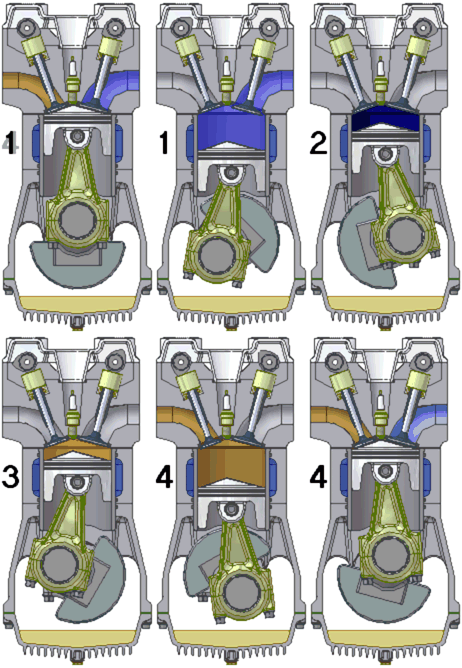
In the full view of the engine which it would look like in a 4 cylinder inline engine, that camera was at the position at the top of the engine near the valves and spark plug. Just in case some don't know. The engine has to go thru 2 revolutions to reach the next combustion. That combustion pushes the piston down 2 times before reaching the next one.

4-Stroke-Engine.gif
 
In the full view of the engine which it would look like in a 4 cylinder inline engine, that camera was at the position at the top of the engine near the valves and spark plug. Just in case some don't know. The engine has to go thru 2 revolutions to reach the next combustion. That combustion pushes the piston down 2 times before reaching the next one.

4-Stroke-Engine.gif

Ineria force is what make it move. that's why every engine have flywheel to keep it going...
 
look like camera built in fuel injector plug noticed how it squirt gas as combustion fire more forward from it...
 
Oh yeah, the gas is pressured towards the spark plugs, a controlled explosion occurs forcing movement of the cylinder.

engine-animation.gif
 
Heres one thing I've been wondering.....is there a maximum rpm that a combustion can keep up? Like if the engine is running too fast and the combustion of fuel is doing fast as it can. I know that some motorcycle engines can go up to 15,000 or so rpm....I am trying to picture how fast combustion happens in every 4 cycle.

R/C (radio control) 2 cycle nitro fueled engines can go up to 40,000 or so rpm. They are very small, less than 1 cu inches. I think nitro burns faster than unleaded gasoline.
 
[yt]4hWZ40120BQ[/yt]

I thought this one is a realistic looking model at a museum. That is a 7 cylinder radial engine that you see in early aircraft.
 
Depending, usually 8k RPM is breaking point for valves, Valves can't open and closes 8,000 times per minutes, at this point when valve wasn't properly open and close, it will lock in and because of too much power in it, can snap the piston arm.

On other hand, you mention motorcycle going 15K RPM, that is ONLY if it is 2 stroke engine. 2 stroke engines don't have valves in it, that is why it can go faster and not breaking anything.

It is all about valves when it comes to RPM limitation.

Heres one thing I've been wondering.....is there a maximum rpm that a combustion can keep up? Like if the engine is running too fast and the combustion of fuel is doing fast as it can. I know that some motorcycle engines can go up to 15,000 or so rpm....I am trying to picture how fast combustion happens in every 4 cycle.

R/C (radio control) 2 cycle nitro fueled engines can go up to 40,000 or so rpm. They are very small, less than 1 cu inches. I think nitro burns faster than unleaded gasoline.
 
Depending, usually 8k RPM is breaking point for valves, Valves can't open and closes 8,000 times per minutes, at this point when valve wasn't properly open and close, it will lock in and because of too much power in it, can snap the piston arm.

On other hand, you mention motorcycle going 15K RPM, that is ONLY if it is 2 stroke engine. 2 stroke engines don't have valves in it, that is why it can go faster and not breaking anything.

It is all about valves when it comes to RPM limitation.

Aren't there 4 cylinder watercooled 4 cycle motorcycle engines that can do 12,000-13,000 rpm? Valves can go higher than 8k rpm depending on the design of the valve train.

The point, I'm not talking about the valves or the pistons. I'm talking about the combustion. How fast fuel burns off to the next combustion cycle....that's all there is. I think higher revving engines use special fuel that burns faster than unleaded gasoline.
 
2 stroke engine can go 30KRPM I think, it has nothing to do with type of fuel. It is more of physically ability to handle at higher RPM. The higher RPM there is, the more horses it produces

Aren't there 4 cylinder watercooled 4 cycle motorcycle engines that can do 12,000-13,000 rpm? Valves can go higher than 8k rpm depending on the design of the valve train.

The point, I'm not talking about the valves or the pistons. I'm talking about the combustion. How fast fuel burns off to the next combustion cycle....that's all there is. I think higher revving engines use special fuel that burns faster than unleaded gasoline.
 
[yt]B6ZbfbE04R0[/yt]

inline 8 cylinder with 32 spark plugs, 4 coils and 4 carbeurators rated at around 850 hp. It's only run at an engine show once a year. I'm sure that engine is really loud!

Also, to add that this gas engine used to pump water in Danville, Illinois.
 
Depending, usually 8k RPM is breaking point for valves, Valves can't open and closes 8,000 times per minutes, at this point when valve wasn't properly open and close, it will lock in and because of too much power in it, can snap the piston arm.

On other hand, you mention motorcycle going 15K RPM, that is ONLY if it is 2 stroke engine. 2 stroke engines don't have valves in it, that is why it can go faster and not breaking anything.

It is all about valves when it comes to RPM limitation.


HMMMM?. I bet to differ sire.. I used to have 2006 YamahaYZF-R6 (598cc) the redline is 15.5K RPM. it is 4 stroke.

here's the link I've provided...

2008 Yamaha YZF-R6S Features & Benefits, model features

I have used it for trackdays extensively. had no problems with it... the only problem I had to replace rear tire more often than I do on oil change... LOL


Just sayin'
 
Last edited:
[yt]sY10X0WDoUo[/yt]

This is a 1000 fps camera at slow motion. I do not know how they do it, I think probably fiber optic attached to a camera outside the engine. It has to be pressure and high temperature resistant, the temperatures inside an engine can go up to over 1800 degrees in some hottest spots of the parts. The process goes really fast and it would be in a blur. This is a 4 cycle engine like in your car.


wow! that is so cool!... thanks for the post! :-o
 
Back
Top