Origami

Do you glue the $1 bills?? If not, how to keep them together in a cube? Wow. :applause:

:ty: for another picture. Please post when you make these! :)
No gluing was required. I simply folded and inserted everything in the tabs. Simple. :)
 
These are interesting. It seems as if you got some 'eye' for art and perhaps, some hand to eye coordination works that helps you pass the time.

As for the origamis, I used to do it when I was a kid. It was fun and now, I'm out of practice because I haven't done it for so long.

Again, It's impressive. ;)
 
These are interesting. It seems as if you got some 'eye' for art and perhaps, some hand to eye coordination works that helps you pass the time.

As for the origamis, I used to do it when I was a kid. It was fun and now, I'm out of practice because I haven't done it for so long.

Again, It's impressive. ;)
Thanks.

I'm currently working on a Menger's Sponge... Level 1. I'm doing it using $1 bills. I could do Level 2, but that would be too much money. If I did manage to do Level 2, I doubt I could do Level 3 since the weight might be too much for the $1 bills.

The cost of making a Menger's Sponge at Level 1 = $192... at Level 2 = $3,456... at Level 3 = $66,048... at Level 4 = $1,296,384.

The weight of a Menger's Sponge made out of $1 bills at Level 1 = almost .5 lbs... at Level 2 = a bit over 7.5 lbs... at Level 3 = 145 lbs... at Level 4 = 2,858lbs (almost 1.5 tons).

I doubt that the Menger's Sponge at Level three will be able to support itself using $1 bills.
 
I agree with Jolie, you certainly do have an eye for art Vamproyz! I havent ever seen any stuff like this before. I struggle making those 'fortune tellers' for kids, those ones that look like frilled neck dragon lizard heads. :giggle:

Maybe there is an outlet to make money from doing stuff like this? And, err, whats a Menger's Sponge??

Kangaroo
 
I agree with Jolie, you certainly do have an eye for art Vamproyz! I havent ever seen any stuff like this before. I struggle making those 'fortune tellers' for kids, those ones that look like frilled neck dragon lizard heads. :giggle:

Maybe there is an outlet to make money from doing stuff like this? And, err, whats a Menger's Sponge??

Kangaroo
Menger's Sponge is a geometric fractal that is infinite.

Menger& - Wikipedia, the free encyclopedia

Imagine taking 27 cubes and stack them up to make one big cube. However, you remove all the middle cubes leaving just the frame... 20 cubes remaining. That's Level 1.

Now, repeat that to make 19 more for Level 1... then set them up just like Level 1 itself. That becomes Level 2. Do it all over again so that you have 20 of Level 2 and set it up... Level 3. This repeats infinitely. The numbers increase exponentially.

Level 1 = 20 cubes
Level 2 = 400 cubes
Level 3 = 8,000 cubes
Level 4 = 160,000 cubes
Level 5 = 3,200,000 cubes
Level 6 = 64,000,000 cubes
Level 7 = 1,280,000,000 cubes
Level 8 = 25,600,000,000 cubes
Level 9 = 512,000,000,000 cubes
Level 10 = 10,240,000,000,000 cubes

Normally, each cube uses 6 sheets of paper. When a level is complete, an extra sheet of paper is used on each exposed face of each cube. If the cube continues to another level, don't do the faces yet until you stopped at a level. That's why the number of sheets of paper increases exponentially.

Someone did a similar project using business cards. She could only stop at Level 3 due to the weight of the whole thing.
 
I was looking into the Menger's sponge and it seems to be fun but yet, challenging since it requires using geometrics.

I am curious, What prompted you to go for this and how did you become interested in this?
 
I was looking into the Menger's sponge and it seems to be fun but yet, challenging since it requires using geometrics.

I am curious, What prompted you to go for this and how did you become interested in this?
It's one of those spur-of-the-moment things where I'm doing one thing and it leads to another.

It originally started with someone in my family doing dollar bill origami and I was asked to make some more for her. So, I went to the bank and got a stack of 100 $1 bills.

I started with a couple easy ones, then looked for some more that were interesting.

There were a lot that seemed non-realistic. "OMG! Look... it's Yoda from Star Wars!" Seriously, it doesn't even look like Yoda. "Oh, wait... someone made a statue of Buddha!" Again, it doesn't even look like Buddha. Those designs were just crumbled up paper that barely looks like what they're intended to be... if we look at them from specific angles.

That's when I decided to try something that were obvious. When I did the star, I thought I'd try finding something harder. That's when I saw the triangle, then the pyramid. Finally, I came across a site talking about this origami club wanting to do a Level 3 Menger's Sponge. After reading about it, I thought... "Why not?"

After doing some math, I realized... Level 1 is the best I can do for $1 bills. :)

I've done origami all my life... on and off. :)
 
UPDATE!!!

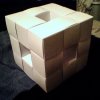
I just completed Level 1 of Menger's Sponge using 3x5 index cards. Whew!

This project consisted of 192 index cards.
 

Attachments

  • cube.jpg
    cube.jpg
    40.4 KB · Views: 17
^ Sweet! How long did it take you to complete Level 1 of Menger's Sponge?

192 index cards?? :eek3: That's a lot and I can imagine level 2 and above would have more than this.

Btw - thanks for sharing your origami experiences. ;)
 
^ Sweet! How long did it take you to complete Level 1 of Menger's Sponge?

192 index cards?? :eek3: That's a lot and I can imagine level 2 and above would have more than this.

Btw - thanks for sharing your origami experiences. ;)
It took me a few hours to make it. Of course, I was watching an anime at the same time.

If I were to make Level 2, it would require 3,456 index cards and weigh about 15 lbs. The whole thing would be 27 inches wide. Would it fit through my door when I'm done with it? Hmm...

The reason why index cards were best for this project is because they're stronger, smaller, and cheaper.

If I did it out of $1 bills, the furthest I could go would be Level 1 because Level 2 is too much money. Plus, the weight might put some strain on the bills.

For index cards, I can get 250 for $1 at the dollar store. For Level 2, it would cost me $14 worth of index cards. That would be worth the project. I might do that next month and take a picture of it when I'm done.

Since it takes me a few hours to do Level 1, multiply that by 20 and that's how long it would take me to do Level 2. Considering that, I might do Level 1 per day... taking me about 20 days to complete it.
 
Okay... I got bored again.

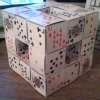
So, I did it using playing cards. :)
 

Attachments

  • cube.jpg
    cube.jpg
    49.9 KB · Views: 11
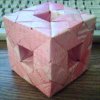
I got tired of doing it using cards and decided to try a different approach.

Instead of simple folds and attaching them together in a simple way, I decided to do complex folds and attach them together in complex ways.

Here's the result... (you'll notice that the pattern is different)
 

Attachments

  • cube.jpg
    cube.jpg
    35.2 KB · Views: 13
Those Menger cube models are interesting. Is there any way to make a paper Sierpinski tetrahedron?

I've made paper models of the Platonic, Archimedean and Kepler-Poinsot solids with the designs on this site back when it had much less.

It is possible to make models like those with origami, especially modular origami. The ones I did were with tabs and glue.

Those got crushed when I was away at RIT. :( So I plan on making new ones using a program to print out the designs for those again plus a lot more such as the Catalan solids, some prisms, some antiprisms, the rest of the uniform polyhedra, the uniform compounds, Johnson solids and some other groups as well as tilings in two and three dimensions. Then once I have those taken care of, there are the four dimensional ones, which includes six convex regular shapes as opposed to only five such polyhedra in three dimensions and an infinite number of regular polygons in two dimensions. Then there are the higher dimensions :eek2: with three convex regular shapes each and many nonconvex ones.

The some of the nonconvex snub polyhedra uniform compounds of their mirror images are each going to take a while to make. On the bottom of this page, George Hart says if someone makes a paper model of the compound of the mirror images of the great inverted retrosnub icosidodecahedron, he would buy them a beer. :beer: His site is a nice introduction to this topic. It is also known as UC72, or the 72nd uniform compound.

From what I've read, at least two models of this exist in the world, so maybe mine could be the third one.:mrgreen: It's going to be hard because the self-intersecting faces of such polyhedra cut each other into little pieces and notches that could be as small as millimeters across even when the whole thing is around a meter across. I figured that the pieces for that one would take up around 350 pages if I printed out the most effective arrangement of parts I was able to get in the program. So, I may print out one instance of each part and use those to make duplicates that don't leave lots of empty paper.

I tried to count up most of what is on my list of what to build and it ended up being over 500 items. I'm sure it'll go way over that, maybe over 1000. Only a few of them really need to be large to be fully detailed. Most of them can be made small and should fit into my room. :lol: I've had practice cutting small things with my exacto knife for another project and got a book from the library about shelves, so I could get ideas about what to design to store all of these things.:eek3: It all started with another book from the library, Shapes, Space and Symmetry, which showed how a lot of those are related to each other.

 
Those Menger cube models are interesting. Is there any way to make a paper Sierpinski tetrahedron?

I've made paper models of the Platonic, Archimedean and Kepler-Poinsot solids with the designs on this site back when it had much less.

It is possible to make models like those with origami, especially modular origami. The ones I did were with tabs and glue.

Those got crushed when I was away at RIT. :( So I plan on making new ones using a program to print out the designs for those again plus a lot more such as the Catalan solids, some prisms, some antiprisms, the rest of the uniform polyhedra, the uniform compounds, Johnson solids and some other groups as well as tilings in two and three dimensions. Then once I have those taken care of, there are the four dimensional ones, which includes six convex regular shapes as opposed to only five such polyhedra in three dimensions and an infinite number of regular polygons in two dimensions. Then there are the higher dimensions :eek2: with three convex regular shapes each and many nonconvex ones.

The some of the nonconvex snub polyhedra uniform compounds of their mirror images are each going to take a while to make. On the bottom of this page, George Hart says if someone makes a paper model of the compound of the mirror images of the great inverted retrosnub icosidodecahedron, he would buy them a beer. :beer: His site is a nice introduction to this topic. It is also known as UC72, or the 72nd uniform compound.

From what I've read, at least two models of this exist in the world, so maybe mine could be the third one.:mrgreen: It's going to be hard because the self-intersecting faces of such polyhedra cut each other into little pieces and notches that could be as small as millimeters across even when the whole thing is around a meter across. I figured that the pieces for that one would take up around 350 pages if I printed out the most effective arrangement of parts I was able to get in the program. So, I may print out one instance of each part and use those to make duplicates that don't leave lots of empty paper.

I tried to count up most of what is on my list of what to build and it ended up being over 500 items. I'm sure it'll go way over that, maybe over 1000. Only a few of them really need to be large to be fully detailed. Most of them can be made small and should fit into my room. :lol: I've had practice cutting small things with my exacto knife for another project and got a book from the library about shelves, so I could get ideas about what to design to store all of these things.:eek3: It all started with another book from the library, Shapes, Space and Symmetry, which showed how a lot of those are related to each other.
The Menger's Sponge is the only thing that can be done without modifying paper in special patterns. For instance, I used index cards and playing cards. They weren't cut in any special way... just folded and connected. The smaller model I made was done using origami paper. I simply cut a regular square sheet of origami paper into 4 smaller square sheets. I didn't cut them into triangles or any unusual shape to make it easier. I just cut them into squares and then folded them as I would with any origami project.

The Sierpinski Tetrahedron? Well, those are triangles with no real connecting points unless I used toothpicks or glues. But then again, if glue or toothpicks were used... then is it a real all-paper model?

Earlier, I made something that is a mix between a tetrahedron and a platonic. That was done using simple 1x3 paper and folded into ways that they can be connected and locked together. You should try that. :)

You probably don't need to do all of those printing. There are patterns that you can find online using 3x4 paper that can be used into any geometric shape.

Try doing a search for "knotology". You'll find something interesting there. :)
 
Wow! Isn't that hard ?? For me, I have NOOOOOOOO patience to sitting and focus on that for hours and hours ?!?!


:afro:

M-
Well, the more complicated the project, the more time it will take.

I've got a lot of patience. It helps to have something else going on to keep me occupied.

That's why I usually watch DVDs when working on these kinds of project.

Right now, I'm working on a Level 2 Menger's Sponge... using the same method as I did for...

http://www.alldeaf.com/899166-post35.html

I've been working on it for 2 days now. I will fold and prepare 40 sheets at a time, then add them to the model. I usually spend 30 minutes to 1 hour each time before waiting until later during the day/evening or tomorrow. :)

I will be doing some today. I'll upload pictures soon... :)
 
Well, the more complicated the project, the more time it will take.

I've got a lot of patience. It helps to have something else going on to keep me occupied.

That's why I usually watch DVDs when working on these kinds of project.

Right now, I'm working on a Level 2 Menger's Sponge... using the same method as I did for...

http://www.alldeaf.com/899166-post35.html

I've been working on it for 2 days now. I will fold and prepare 40 sheets at a time, then add them to the model. I usually spend 30 minutes to 1 hour each time before waiting until later during the day/evening or tomorrow. :)

I will be doing some today. I'll upload pictures soon... :)

Wow, God bless ya that u have a good patience just like my husband, He is such wonderful patience than I do! Lol... no wonder, Im orginallly from New York City! ! :whistle:

Ya know, For New Yorker people- Mostly them have no "patience".... just like come on and hurry up! ! blahhh blahhhh....( not pretty attitude). Lol

:afro:

M-
 
Back
Top