

gnarlydorkette
New Member
- Joined
- Oct 6, 2003
- Messages
- 1,757
- Reaction score
- 0
I saw my first red tides during nighttime less a month ago... Here I am, 19 yearsold, growing up on beaches and I just saw redtides for first time! When it is nighttime and dark, the redtides emit a blue glow whenever their waves break and crash into the shore. an AMAZING sight! You can stomp on the sands and you will see blue flashes from the sand! (The water is soaked in the sand so it still emit blue glow when stimulating)
I didn't have my camera with me then (I could make a short film)... and the red tides "season" is over so I will wait until the temperature is warm and the sea is polluted again so I can make a film clip for yall to see!
Read on....

I didn't have my camera with me then (I could make a short film)... and the red tides "season" is over so I will wait until the temperature is warm and the sea is polluted again so I can make a film clip for yall to see!
Read on....
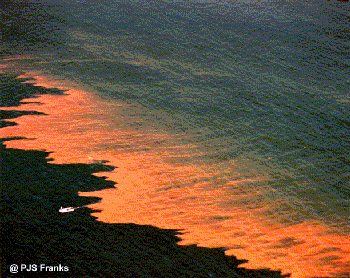
Red tides are caused by a group of organisms known as dinoflagellates, which are a type of phytoplankton. Red tides occur whenever dinoflagellate abundance in the water is so high that they can change the colour of the water- scientists call this a phenomenon a "bloom" of dinoflagellates. The reason that the colour of the water is changed is simply because many dinoflagellate species contain lots of red pigment- other types of phytoplankton can cause brown, green, or even purple tides!
There are lots of reasons why red tides occur, both natural and man-made; both basically require the addition of nutrients. Natural red tides can occur when nutrient levels are increased by the movement of deep oceanic water (which is rich in nutrients) to the surface, followed by a warming of the water, which traps it in the surface. Less natural, of course, is the addition of nutrients by man in the form of pollution. So, when those dinoflagellates are trapped together in surface waters with all those nutrients, you can't blame them for starting to grow like crazy! Of course, the large number of people who live along the ocean, and the resulting huge amounts of nutrients we're pumping in the ocean in the form of pollution have made red tides much more frequent in recent years.
(source: www.madsci.org/posts/archives/jul99/932317854.Mi.r.html )
Red tide can occur any time during the boating season if weather conditions are right. Dry sunny spells followed by a sudden storm can encourage the red tides to multiply, and physical conditions such as winds, tides, and currents can act to contain and concentrate the organisms in one place.
Some red tide organisms emit a bluish green bioluminescent light that can make the waves glow at night
(source: http://seagrant.gso.uri.edu/factsheets/redtide.html)
The cells have tiny sacs of enzymes that react when the cell is jostled (for example by the breaking surf). When the enzymes react, they give off a bluish flash of light. So our waves (and your footsteps on the beach; your hands and feet when you swim) will be adorned with gorgeous flashes of light at night.
Suggestion: The bioluminescence of these cells is on a circadian rhythm - they don't bother making light during the day because no one could see it. Try this to amaze your friends and children - get a clear jar or bottle, and fill it with some water from the surf zone (ask a friendly neighborhood surfer to fill it for you in deeper water, to get less sand in it). Take your bottle home, and wait until after the sun has gone down. Then take your bottle into a dark room (bathroom or closet with no windows). Wait for your eyes to adjust to the darkness (a minute or so), and then give your bottle a swirl. You should see a really amazing light show. For extra added excitement, add some vinegar to the bottle. You'll get a particularly bright flash (but then all the cells will die, so it only works once). The acid of the vinegar makes the enzymes react inside the cell, even without stirring.
Is the water toxic?
In general, water containing "red tide" is not harmful to recreate in. Showering after swimming or surfing in water that contains an algal bloom is advised. In fact, showering after swimming or surfing is always a good idea. In some very unusual circumstances, due to coastal wind and wave action, HAB biotoxins can be transported by and through the air, causing severe eye, nose, and throat irritation. In other instances, obnoxious odors and smells can emanate from blooms, especially in confined tidewaters and bays.
(source: http://www.surfrider.org/a-z/red_tide.asp)


