NASA Focuses Next Mission on Venus, Asteroid or the Moon

I think they should make the next mission to land on asteroid so that we can figure out how to divert one if it's headed for earth. An impact could wipe us out.
 
I think they should make the next mission to land on asteroid so that we can figure out how to divert one if it's headed for earth. An impact could wipe us out.

if we're going to focus time and money on asteroid diversion.... then the humanity is lost. We should reallocate that time and money on space colonization and accept the fact that one day Earth may get wiped out.... at least we didn't put all the eggs in one basket!

:cool2:
 
if we're going to focus time and money on asteroid diversion.... then the humanity is lost.......:cool2:
I don't follow. How so? How is humanity lost if we investigate how to avoid something crashing into earth that could wipe us out. :confused:
 
FOXNews.com - NASA Focuses Next Mission on Venus, Asteroid or the Moon

Which one do you think the NASA should choose? :hmm:

Me... Moon Why? We need to set up a base as a port for our future Mars missions and a colony for human beings.

if we're going to focus time and money on asteroid diversion.... then the humanity is lost. We should reallocate that time and money on space colonization and accept the fact that one day Earth may get wiped out.... at least we didn't put all the eggs in one basket!

:cool2:

Agreed.
 
I don't follow. How so? How is humanity lost if we investigate how to avoid something crashing into earth that could wipe us out. :confused:

because it's as futile as trying to stop earthquake from happening, volcano from erupting, and tsunami from flooding. if the asteroid's big enough to wipe out ENTIRE Earth or even half of it - you bet your ass that even Star Trek cannot stop it. You need a Death Star to destroy it.

The humanity has a much higher chance of survival if the time and money are spent on space colonization or deep sea colonization. We can achieve that objective much better than trying to destroy/move asteroid. if the asteroid is going to wipe out Earth, then it's inevitable.
 
NASA Report on Asteroids Suggests Nuclear Option
Scientists have sent Congress a report on ways to prevent an asteroid from hitting Earth. Among the proposals: Use nuclear weapons to nudge a big space rock off a collision course. Some scientists don't think much of that idea.

STEVEN INSKEEP, host:

Oh, this has been the subject of movies and novels and maybe a few of your daydreams.

How would you stop an asteroid that is on a collision course with Earth? Now, a NASA report says nuclear weapons might offer the best chance to stop it. It's just one conclusion of the report, which Congress requested. Another is that it could cost a billion dollars to find and track all the asteroids that might cause catastrophic damage.

NPR's Nell Boyce has more.

NELL BOYCE: A few years back, California Congressman Dana Rohrabacher held some hearings on killer asteroids. He heard from one scientist who tried to put things in perspective, saying your risk of being hurt by an asteroid is about the same as your odds of getting a royal straight flush in Las Vegas.

Representative DANA ROHRABACHER (Republican, California): And interestingly enough, I did go to Las Vegas once and got a royal straight flush. So, the argument actually reinforced to me what the real danger is out there.

BOYCE: To try to reduce that danger, Rohrabacher and other members of Congress recently asked NASA to lay out what it could do to better track threatening space rocks. Lawmakers recently got the report, which notes that NASA already keeps an eye out for big truly planet-threatening objects. It's a program called Space Guard, and it costs about $4 million a year. Dave Steitz is a NASA spokesperson.

Mr. DAVE STEITZ (Spokesperson, NASA): Currently, NASA has a program that is looking to track up to 90 percent of the near-Earth asteroids that are bigger than a kilometer, pretty big objects that are coming close to Earth.

BOYCE: NASA has found about 700 of these really big ones. And scientists have stumbled across a bunch of smaller ones, too. Say, the size of a football stadium. There are probably a lot more of those. If one smacked into earth, it could take out a city or cause a tsunami. So, two years ago, Congress said NASA should look into tracking these smaller rocks as well. NASA's Dave Steitz says the agency has now outlined several ways to do so. For example, by using two ground-based telescopes and building another telescope in space.

Mr. STEITZ: We could probably complete a sky survey by the year 2020. To do that would probably require about a billion dollars, and that's money we don't currently have.

BOYCE: The new report is drawing mixed reactions. Former astronaut Rusty Schweickart is chairman of the B612 Foundation, a group dedicated to protecting the Earth from asteroid strikes. He thinks NASA has laid out some good options. He just wishes the agency had said which one it likes best.

Mr. RUSTY SCHWEICKART (Chairman, B612 Foundation): NASA basically declined to do it. I mean, they quite literally said, you know, we're afraid that you're just going to tell us to do it without giving us any money. And so, we're not going to tell you which program we recommend.

BOYCE: Schweickart is also dismayed that the report says the best way to stop killer asteroids would be nuclear weapons.

Mr. SCHWEICKART: Space is weapons-free. It's a very, very touchy subject internationally, and it should be. And there are even international treaties that ban it.

BOYCE: He says most asteroids could be deflected with something like a gentle push from a rocket. At least one key lawmaker, the chairman of the House Committee on Science and Technology, has said he's skeptical of the report. Congressman Dana Rohrabacher is also in the committee. He hopes NASA will get some more money to deal with asteroids. He says if we're going to spend hundreds of billions of dollars fighting terrorism.

Rep. ROHRABACHER: We should be able to spend hundreds of millions of dollars in order to protect us from an asteroid or a comet that would do far more damage than the terrorists could ever imagine.

BOYCE: For the moment, however, it appears that asteroid hunters are going to have to make do with the money they have.

Nell Boyce, NPR News.

(Soundbite of music)

INSKEEP: You're listening to NPR News.
 
Nukes Are Not the Best Way to Stop an Asteroid
Nuclear weapons could be used to stop earth-bound asteroids, but in most instances, they are not the best option, said Apollo astronaut Rusty Schweickart during a public lecture this Wednesday in San Francisco.

The venerable scientist explained that all but the largest heavenly bodies can be redirected by rear-ending or towing them with an unmanned spacecraft. But last year, NASA issued a report stating that using nukes is the best strategy to prevent a catastrophic collision with earth.

Although Schweickart has a great deal of faith in the agency, enough to risk his life piloting their lunar lander, he feels that they issued the misleading statement — under immense political pressure. It was a nefarious excuse to put nuclear weapons in space.

Rusty His own organization, the B612 Foundation, intends to use gentler tactics to alter the course of an asteroid by 2015.

Right now, humans are not tracking most of the objects that could cause serious damage to earth, but in the next century, as powerful new telescopes come online, we will begin watching many of them. When that day comes, we will know which ones stand a chance of hitting earth, and it will be time to make some tough decisions.

Since tracking asteroids contains an element of uncertainty, there will be a lot of false alarms, so it may not be necessary to take action at all. If it must be stopped, should we bump it, drag it, or blow it off course?

The astronaut compares our current situation to standing blindfolded in a batting cage. Right now, we can’t do anything, but we know that some balls are hurling towards us. In a few years, our blindfold will come off, and the whole world will be forced to decide — together — when to duck.
 
Moon hole might be suitable for colony
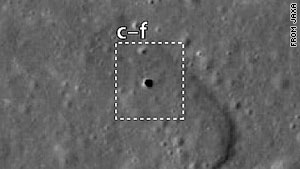
story.lunar.hole.courtesy.jpg


(CNN) -- Building a home near a moon crater or a lunar sea may sound nice, but moon colonists might have a much better chance of survival if they just lived in a hole.

That's the message sent by an international team of scientists who say they've discovered a protected lunar "lava tube" -- a deep, giant hole -- that might be well suited for a moon colony or a lunar base.

The vertical hole, in the volcanic Marius Hills region on the moon's near side, is 213 feet wide and is estimated to be more than 260 feet deep, according to findings published in Geophysical Research Letters, a journal of the American Geophysical Union.

More important, the scientists say, the hole is protected from the moon's harsh temperatures and meteorite strikes by a thin sheet of lava. That makes the tube a good candidate for further exploration or possible inhabitation, the article says.

"Lunar lava tubes are a potentially important location for a future lunar base, whether for local exploration and development, or as an outpost to serve exploration beyond the Moon," writes the team, led by Junichi Haruyama, a senior researcher with the Japanese space agency JAXA.

"Any intact lava tube could serve as a shelter from the severe environment of the lunar surface, with its meteorite impacts, high-energy UV radiation and energetic particles, and extreme diurnal temperature variations."

Lava tubes have previously been discovered on the moon, but the scientists say the new hole is notable because of its lava shield and because it does not appear to be prone to collapse.

Lave tubes exist on Earth and also have been found on Mars. The cylinder-shaped caverns can be carved out by lava flows, volcanic eruptions, seismic activity or ground collapse resulting from meteoroid strikes.

The scientists used high-resolution images from a Japanese moon orbiter called SELENE to discover this lunar lava tube. The findings were published November 12, but they grabbed the attention of the public this week.

NASA is reportedly working on plans to return to the moon by 2020 and to set up a temporary lunar colony by 2025 as part of the Constellation Program. Funding for the program, however, remains somewhat in question.

The American space agency could not be reached for comment.

 
I would never suggest to use nukes to blow up an asteroid. If you did now you have thousands of smaller pieces that can fall to earth and cause damage not to mention the radioactive fallout. Instead, and as mentioned in your quote,

BOYCE: He says most asteroids could be deflected with something like a gentle push from a rocket.

Rep. ROHRABACHER: We should be able to spend hundreds of millions of dollars in order to protect us from an asteroid or a comet that would do far more damage than the terrorists could ever imagine.

As I understand it, the idea is to land on an asteroid or comet with some sort of thrusters that would be used to nudge the neo off of its collision course with earth. If we don't conduct tests landing on these objects we won't know what types of anchor systems would be needed for the thrusters. I am no expert but to me that sounds feasible and makes a whole lot more sense that nuking them.
 
I would never suggest to use nukes to blow up an asteroid. If you did now you have thousands of smaller pieces that can fall to earth and cause damage not to mention the radioactive fallout. Instead, and as mentioned in your quote,
smaller pieces are better than 1 large piece. sometimes not.

As I understand it, the idea is to land on an asteroid or comet with some sort of thrusters that would be used to nudge the neo off of its collision course with earth. If we don't conduct tests landing on these objects we won't know what types of anchor systems would be needed for the thrusters. I am no expert but to me that sounds feasible and makes a whole lot more sense that nuking them.

yes you are correct that nuking it is silly and dumb. Using thrusters to steer it out of the way just by few degrees is the "best option" right now but to me - it's useless. in order to do this - we need to do this THOUSAND THOUSAND THOUSAND THOUSAND miles away. Not 5,000 miles... it's too late. This has to be done over several hundred miles away to make it work.

It's like throwing a dart to bull's eyes...... from 50 yards away.

and plus...... we have no way of knowing if this will work or not because how are we supposed to experiment this with trials and errors?
 
.................... Using thrusters to steer it out of the way just by few degrees is the "best option" right now but to me - it's useless. in order to do this - we need to do this THOUSAND THOUSAND THOUSAND THOUSAND miles away. Not 5,000 miles... it's too late. This has to be done over several hundred miles away to make it work.

It's like throwing a dart to bull's eyes...... from 50 yards away.

and plus...... we have no way of knowing if this will work or not because how are we supposed to experiment this with trials and errors?
Agreed. Nobody suggested waiting until it is 5k miles away. My only point was that it is something important for NASA to investigate. And you are right. We have no way of knowing if this will work which is why we should start investigating it. That is why I voted to land on an asteroid for their next mission. So they can start investigating what it will take. Trust me. NASA has the capability of landing on an asteroid or comet right now if they wanted to. It's a matter of getting buy in and the funding to back the research.
 
It's something that we don't know what is going on at Area 51. They must have ahead of time or they have a Stargate in the building.
 
Agreed. Nobody suggested waiting until it is 5k miles away. My only point was that it is something important for NASA to investigate. And you are right. We have no way of knowing if this will work which is why we should start investigating it. That is why I voted to land on an asteroid for their next mission. So they can start investigating what it will take. Trust me. NASA has the capability of landing on an asteroid or comet right now if they wanted to. It's a matter of getting buy in and the funding to back the research.

oh yes - I'm aware of our satellites landing on comet and tailing it to its chemical analysis on it but that was a very simple mission. Just crash and burn into comet. But for this project - in order to veer asteroid off, you need to place the thrusters on strategic locations on asteroid/comet. That's..... pretty damn tricky to do that. and we don't know for sure if it'll work on asteroid because asteroid is a very very very hard solid rock. There's no guarantee that "crash and burn" method into asteroid will work. The thrusters may be destroyed upon impact. :dunno:

Trust me - you don't wanna do this if it's 5,000 miles away. 5,000 miles may sound pretty damn far away but if the thrusters failed..... we have a very very very short time left to make amend and to make love before the end is here. :)

I'm not saying NASA should completely abandon this idea but just in my opinion - it's futile and we should just make love :) I suppose we can play with trials and errors on our asteroid belt.
 
Know what is funny? I happened to finish watching the Meteor that I recorded on my HD PVR last night. The Russians and Americans worked together to launch their nuclear missiles to destroy a huge meteor named Ophreus. :laugh2:

lol! what was the result?
 
oh yes - I'm aware of our satellites landing on comet and tailing it to its chemical analysis on it but that was a very simple mission. Just crash and burn into comet. But for this project - in order to veer asteroid off, you need to place the thrusters on strategic locations on asteroid/comet. That's..... pretty damn tricky to do that. and we don't know for sure if it'll work on asteroid because asteroid is a very very very hard solid rock. There's no guarantee that "crash and burn" method into asteroid will work. The thrusters may be destroyed upon impact. :dunno: ...........
That is exactly why I believe NASA should continue to investigate. If anyone has the knowledge and capabilities to pull it off, NASA does. I don't agree that it is a futile effort.
 
If an asteroid hit Earth...won't that be considered as an act of God?
 
Back
Top