

- Joined
- Apr 27, 2007
- Messages
- 69,254
- Reaction score
- 144
Haiti cruise stops draw ire, support
* Royal Caribbean cruise line takes heat for bringing tourists to Haiti after the quake
* Some people are outraged and disgusted at the idea of tourists frolicking near the disaster zone
* Experts: Reaction is natural, but people should consider the benefits of tourism for Haiti
* "The cruise ships aren't hurting anyone, in fact they're doing some good," ethics expert says
(CNN) -- When Catherine Jones recently booked a Royal Caribbean cruise that included a stop in Haiti, she never expected that her vacation would lead to deep soul searching and an emergency family meeting.
Jones, who lives in Hickory, North Carolina, is scheduled to start the trip at the beginning of next month -- a five-day getaway with her sister, who is in the Army and will go to Afghanistan in March, and their 87-year-old mother.
"We kind of discussed it: How can you sit there and say, 'Waiter, bring me a drink' while I'm on a private beach ... knowing that 100 miles away, people are dying," Jones said.
It's a debate that's been raging ever since Royal Caribbean resumed bringing vacationers to Haiti after last week's earthquake, which killed tens of thousands of people in and around the capital of Port-au-Prince.
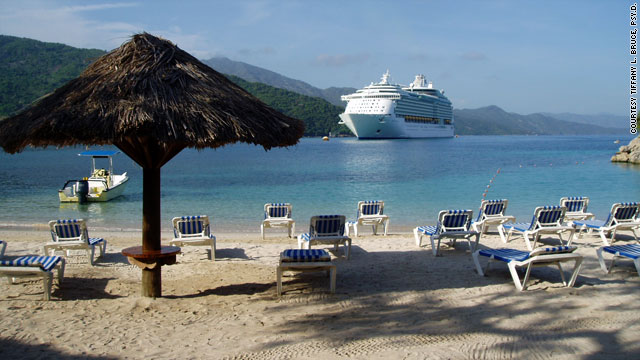
Royal Caribbean deposits the tourists on the picturesque peninsula of Labadee, which was unaffected by the disaster and where the company has spent millions of dollars on what it calls its own "private paradise."
The area is heavily guarded, and visitors don't spend the night. But they enjoy Labadee's "pristine beaches, breathtaking scenery and spectacular water activities," according to Royal Caribbean's Web site.
Blogs and message boards have been full of outrage and disgust at the idea of tourists frolicking in the sun while bodies pile up in Port-au-Prince and quake survivors struggle to stay alive.
"Royal Caribbean is performing a sickening act to me by taking tourists to Haiti," wrote one poster on CNN's Connect the World blog.
"Having a beach party while people are dead, dying and suffering minutes away hardly makes me want to cruise that particular line," wrote another.
What's the right thing to do?
Experts in ethics and sustainable tourism said that kind of reaction is natural and understandable, but they urged people to look deeper at the issue and consider the benefits of tourism for Haiti now and beyond.
"Monies that are coming in as part of tourism are going to trickle down throughout the local economy at a time when the local people need it the most," said Brian Mullis, president of Sustainable Travel International, a nonprofit organization that promotes responsible travel.
Because visitors can have a positive effect during their stay, tourism should still be taking place in Haiti, even at this terrible time, Mullis said.
In a statement issued after the earthquake, the United Nations World Tourism Organization also weighed in, saying that "tourism can become a useful instrument for the necessary reconstruction process in Haiti."
History shows other examples of the importance of tourism to devastated areas: New York inviting visitors after the September 11, 2001, terrorist attacks and New Orleans, Louisiana, appealing for tourist dollars after Hurricane Katrina in 2005.
Cruise line responds
Meanwhile, Royal Caribbean announced it would donate at least $1 million in humanitarian aid to Haiti and contribute all of the company's net revenue from Labadee to the relief effort.
The company's cruise ships are also delivering supplies -- including rice, dried beans, powdered milk, water and canned goods -- to the region.
Officials with the cruise line have been trying to reassure customers who may be having second thoughts about going on a trip that includes a stop in Haiti.
"It isn't better to replace a visit to Labadee (or for that matter, to stay on the ship while it's docked in Labadee) with a visit to another destination for a vacation," Adam Goldstein, president and CEO of Royal Caribbean International, wrote on his blog.
"Why? Because being on the island and generating economic activity for the straw market vendors, the hair-braiders and our 230 employees helps with relief while being somewhere else does not help."
Royal Caribbean says it has been one of Haiti's largest foreign investors for almost 30 years. The company spent $50 million developing Labadee, Goldstein told NPR.
Considering the ethics
Haiti's plight wouldn't improve if the cruise ships were diverted to another nearby island and pretended the disaster wasn't happening, agreed Chris MacDonald, a senior fellow at Duke University's Kenan Institute for Ethics and a philosophy professor at Saint Mary's University in Halifax, Nova Scotia. He also writes The Business Ethics Blog.
"The cruise ships aren't hurting anyone, in fact they're doing some good, they're bringing some help," MacDonald said.
People who believe it's disrespectful for tourists to enjoy themselves so close to a disaster zone should realize that the alternative of avoiding the area wouldn't be more respectful, MacDonald added.
The proximity sets off our gut reactions, but it doesn't seem to make any real moral difference, he said.
Mullis pointed out that the Dominican Republic -- Haiti's touristy neighbor on the island of Hispaniola -- is also close to the disaster but is doing business as usual.
"Anyone who doesn't feel a bit of awkwardness at the thought of beach volleyball in the north of Haiti right now doesn't have normal moral intuitions," MacDonald said.
"[But] the world needs to signal that Haiti isn't now just this fenced-off, quarantined place where you can never invest, you can never do business. Haiti is, to some tiny extent, still open for business. That's a hopeful message in a very, very grim situation."
It's a message Catherine Jones is taking to heart.
After much discussion, she and her family are going forward with their Royal Caribbean cruise that will include a stop in Labadee, Haiti. She won't be able to enjoy herself that day, Jones said, but she is hoping the money she spends will help the locals, and she is comforted by that thought.
"It's one of those situations that you can have a million views on it. But the fact is it happened, they depend on us for our money that we bring, I guess we'll go," Jones said.
The Royal Caribbean cruise line has been under fire for taking vacationers to earthquake-ravaged Haiti. But experts in ethics and sustainable tourism say the cruise stops will bring benefits to Haiti now and in the future.


