The Southern Cross

AJ

New Member
Joined
May 24, 2003
Messages
3,311
Reaction score
0
ok i have been given the gift of a second chance for my flag.
understand...this is a thread to discuss your views on the Southern Cross/Confederate Battle Flag. this is not a thread to bash others,this is not a thread to name call. if someone doesn't share your views then back up your opinion with facts not curse words.

so.....

I love the Southern Cross. i understand that it has been associated with some pretty dumbass things, like the KKK and the SkinHeads and other racist groups, but thats not what the flag was made for. it wasn't made for a hate group, thats just who took over it and "dragged it through the mud" as a smart ADer had put it. and listen to this...because this seemed to get lost in the war of righteousness in the other Thread. I Am Trying To Take A Negative Flag And Turn It Into A Positive Flag. as i've said before i can not change the past but im damn well going to try to change the future of this flag. and if people get behind me with this issue then together we can wipe away the horrible image this flag has taken. and for those who want to keep it a "racist" flag....then thats your opinion. but get out of my way, because im not going to let you hold me down from reaching my goal. and as stated before my goal is to shed the Rebel Flag and emerge it into The Southern Cross, as it once was called. and if u would like web sites here you go.


http://www.sonofthesouth.net/leefoundation/Confederate_Flag.htm
http://www.dixiecom.com/blackneo.htm
http://confederatezone.50megs.com/photo4.html
http://www.coax.net/people/lwf/cwappoma.htm
http://www.usgennet.org/usa/mo/coun...uis/blackcs.htm

if u want to read more about the Confederate flag i suggest u go to the now locked Thread The Rebel Flag. a lot of people have posted some very interesting things.

and i also, highly suggest u do ur homework before u post, instead of just coming on here instead of coming here and just letting false facts fly.

i would really like to keep this thread open. because whether u like the flag or u dont, its historical. and many people can learn something from here and decided for themselves whether they like the flag or not.
 
so because no one can bad mouth eachother....no one wants to post a responce in this thread.
 
I like the Southern Cross Flag's idea. I 100% complete support with State right over with the Federal right.
 
Black Contributions to the Civil War:

"There are at the present moment, many colored men in the Confederate Army doing duty...as real soldiers, having muskets on their shoulders and bullets in their pockets...." Frederick Douglas, former slave & abolitionist (Fall, 1861)

How many? Easily tens of thousands of blacks served the Confederacy as laborers, teamsters, cooks and as soldiers.

Why? Blacks served the South because it was their home, and because they hoped for the reward of patriotism; for these reasons they fought in every war through Korea, even though it meant defending a segregated United States.

Emancipation? President Lincoln's Emancipation Proclamation did not free a single slave. Issued at a time when the Confederacy seemed to be winning the war, Lincoln hoped to transform a disagreement over secession into a crusade against slavery, thus preventing Great Britain (and France) from intervening on the side of the South. The proclamation allowed slavery to continue in the North as well as in Tennessee and large parts of Louisiana and Virginia. It applied only to Confederate-held slaves, which Lincoln had no authority over, but not to slaves under Federal control.

Lincoln's Views? "I am not in favor of making voters or jurors of Negroes, nor of qualifying them to hold office...." 9/15/1858 campaign speech "I have no purpose, directly or indirectly, to interfere with the institution of slavery...." 3/4/1861 First Inaugural Address "I am a little uneasy about the abolishment of slavery in this District [of Columbia]...." 3/24/1862 letter to Horace Greeley "If I could save the Union without freeing any slave I would do it...." 8/22/1862 letter to Horace Greeley, New York Tribune editor

Confederate: Famed bridge engineer and former slave Horace King received naval contracts for building Confederate warships. A black servant named Sam Ashe killed the first Union officer during the war, abolitionist Major Theodore Winthrop. John W. Buckner, a black private, was wounded at Ft. Wagner repulsing the U.S. (Colored) 54th Massachusetts Regiment. George Wallace, a servant who surrendered with General Lee at Appomattox, later served in the Georgia Senate. Jim Lewis served General Stonewall Jackson, and was honored to hold his horse "Little Sorrel" at the general's funeral. Captured black cook Dick Poplar suffered cruelty by Yankee Negro guards at Pt. Lookout, MD for being a "Jeff Davis man."

Union: A daring Robert Smalls engineered theft of the CSS Planter, presenting it to the Yankee blockading fleet at Charleston. Black Medal of Honor awardees Christian Fleetwood and William Carey bravely carried the banner at Ft. Wagner's assault in 1863.

Colonial: The first man to die for the American cause of freedom was Crispus Attucks, a black seaman from Boston. At the time of the American Revolution, New York City held almost as many slaves as all of Georgia combined.

Surprising Facts: In St. Louis, General John Fremont freed slaves of "disloyal" Missouri Confederates; an angry Lincoln fired him. Slaves in Washington, D.C. were not freed until April 1862, a year after the war began with the firing at Ft. Sumter. Slavery continued throughout the entire war in five Union-held states: DE, MD, WV, KY and MO. The New York City draft riots of July 1863 resulted in burning of a beautiful black orphanage and lynching of blacks. A provision in the Confederate Constitution prohibited the African slave trade outright (unlike the U.S. Constitution). Encouraged by General Lee, the CSA eventually freed slaves who would join the army, and did recruit and arm black regiments. C.S. General Robert E. Lee freed his family slaves before the war; Union Gen. U.S. Grant kept his wife's slaves well into the war. Many blacks owned slaves themselves. In 1861 Charleston, for example, a free colored planter named William Ellison owned 70 slaves. Even in 1830 New York City, three decades before the war, eight black planters owned 17 slaves.

Blacks Today: Nelson W. Winbush, a retired educator and SCV member, lectures on his black Confederate ancestor, private Louis N. Nelson. A black Chicago funeral home owner, Ernest A. Griffin, flies the CSA battle flag and erected at his own expense a $20,000 monument to the 6,000 Confederate soldiers who are buried on his property, once site of the Union prison Camp Douglas. Black professor Leonard Haynes (recently deceased) of Southern University (Baton Rouge) spoke regularly on black Confederates. American University's professor Edward Smith also lectures on the truth of black Confederate history and, with Nelson W. Winbush, has prepared an educational videotape entitled "Black Southern Heritage" (available at (954) 963-4857)

Info? Contact: Dr. Edward Smith, American University, 4400 Massachusetts Ave., N.W., Washington, D.C. 20016 (202) 885-1192; Dean of American Studies, Dr. Smith (a black professor) is dedicated to clarifying the historical role of blacks.

Websites: Library of Congress Black History Resource Guide -

http://lcweb.loc.gov/exhibits/african/intro.html
 
Hispanic Contributions to the Civil War:

Confederate:

• José Agustín Quintero, a Cuban poet and revolutionary, ably served Confederate President Jefferson Davis as the C.S. Commissioner to Northern Mexico, ensuring critical supplies from Europe flowed through Mexican ports to the CSA.


• Santiago Vidaurri, governor of the border states of Coahuila and Nuevo León, offered to secede northern Mexico and join the Confederacy; Jefferson Davis declined, afraid the valuable "neutral" Mexican ports would be then blockaded.


• The Spanish inventor Narciso Monturiol offered the Confederacy his advanced submarine Ictineo to smash the Federal blockade. Never purchased, Jules Verne apparently based the Nautilus on this, the world's most advanced vessel of the day.


• Ambrosio José González, a famous Cuban revolutionary, served Confederate general P.G.T. Beauregard as his artillery officer in Charleston; earlier, in New York, he helped design the modern Cuban and (inversed) Puerto Rican flags.


• The Mexican Santos Benavides, a former Texas ranger, commanded the Confederate 33rd Texas Cavalry, a Mexican- American unit which defeated the Union in the 1864 Battle of Laredo, Texas. He became the only Mexican C.S. colonel.


• Thomas Jordan, a Confederate general responsible for early codes used in spying on Washington, after the war led the Cuban revolutionary army as Commander-in-Chief, training its generals and in 1870 routing the Spaniards at two-to-one odds.


• Lola Sanchez, of a Cuban family living near St. Augustine, had her sisters serve dinner to visiting Federals, while she raced out at night and warned the nearest Confederate camp. The Yankees thus lost a general, his unit and a gunboat the next day.


• Loretta Janeta Velazquez, a Cuban woman, claimed to have fought in the war disguised as a Confederate soldier, Lt. Harry Buford. She chronicled her amazing and harrowing adventures in an account called The Woman in Battle.


• James Hamilton Tomb, a Confederate engineer on the innovative semi-submarine ship David, accepted a post-war offer from the Brazilian emperor as technical expert on torpedoes (submarine mines) in the Paraguayan War of 1865-1870.


• Hunter Davidson, a Confederate torpedo (submarine mine) scientist, assumed the head of the Argentine Torpedo and Hydrographic Bureau for some years, training its leadership, and retired to Asunción, Paraguay, where he is buried.


• John Randolph Tucker, head of the Charleston Confederate Naval Squadron, accepted a post-war position as Vice-Admiral heading the combined Peruvian-Chilean fleets in a Pacific conflict against Spanish coastal incursions.


• John Newland Maffitt, who before the war captured illegal slave-trading ships, served the Confederacy as the CSS Florida's commander. Afterwards, he served in the Paraguayan war and commanded the Cuban gun-runner Hornet.


• Thomas Jefferson Page, a Confederate naval commander who learned of the war's end in Cuba after sailing the ironclad CSS Stonewall from Spain, settled in Argentina, his son becoming an Argentine naval commander, his grandson an admiral.


• Mexican service influenced Confederate general Stonewall Jackson; he often spoke Spanish endearments to his wife, Anna. • After the war, many prominent governors and other Confederates established a colony, Carlotta, in Mexico.

source


I enjoyed the Q&A chat on this site (click to visit site)


Everyone's emotions about the Battle Flag are based on what it means to them. Here are some common opinions and my feelings to go along with them. I modeled it after a conversation I had one night on AOL.


Hippie Guy: That flag is Evil!!

Me: Why?

Hippie Guy: It represents slavery.

Me: How did you come to that conclusion?

Hippie Guy: Because the Confederacy had slaves and that flag represents the Confederacy.

Me: The United States had slavery. So did the British Empire, the Spanish, the Romans, and Egyptians to name a very few. I guess the American,British, Spanish, Italian, and Egyptian flags are all evil too,huh?

Hippie Guy: No, because the South fought a war to keep slavery alive.

Me: General Lee and General Stonewall Jackson abolitionists. Slave States fought for the Union. Why did slavery exist in the Union until well after the end of the war? The War between the States had nothing to do with slavery. Of course, it's convenient that the winners get to write the history to seem that way.

Hippie Guy: Tthe Ku Klux Klan using that flag and they represent bigotry and intolerance. What about that?

Me: The KKK also uses the American flag, the Christian Cross, and the Bible. The one thing the Confederate Battle Flag has in common with these other symbols is that none of them belongs to the Klan. They are all just things that the Klan uses to try and transfer people's affections for the sacred symbols onto their misguided group.

Hippie Guy: Still, The Confederacy stood for a lot of things I don't agree with.

Me: I'll agree. Slavery was wrong and it did exist in the Confederacy. I also think it was wrong what the U.S. government did to the Natives. Does that mean we'll brand the Stars and Stripes an emblem of hate and injustice? Or will we take the good with the bad and love it for what it is? Our flag. Southerners know bad things happened under the Confederate Flag, but a lot of good things happened too. Please respect our wish to take the good with the bad and love our flag just for being our flag.
 
battle_flag_800x600.gif
 
standwatie.jpg

Brigadier General Stand Watie, C.S.A.,

General Watie planned the successful raid into northern Indian Territory.
He had to wait for nine months before his plan was approved by the Confederate high command.
When offered overall command of the expedition, he graciously turned command over to Brigadier General Richard M. Gano since Gano's commission
predated Watie's by one month. Watie remained in command of the Cherokee, Creek
and Seminole cavalry totaling 800 men who fought alongside their Texas brothers-in-arms.

Watie was the only Native American on either side to rise to a brigadier general's
rank during the war. On June 25, 1865, two months after Robert E. Lee's surrender,
he officially surrendered his command of the First Indian Brigade, C.S.A to federal
authorities at Doaksville near Fort Towson in the Choctaw Nation.

He was the last Confederate general in the field to surrender.


Stand Watie (12 December 1806-9 September 1871) (also known as Degataga "standing together as one," or "stand firm" and Isaac S. Watie) was a leader of the Cherokee Nation and a brigadier general of the Confederate States Army during the American Civil War. He commanded Cherokee, Creek and Seminole Indian cavalry under the CSA.

Watie was born near Rome, GA, son of Oo-watie (David Uwatie) and the part-English Susanna Reese. He was the brother of Gallegina "Buck" Watie (Elias Boudinot). The brothers were nephews of Major Ridge, and cousins to John Ridge. The Watie brothers stood in favor of the Removal of the Cherokee to Oklahoma and were members of the Ridge Party that signed the Treaty of New Echota. The anti-Removal Ross Party believed the treaty was in violation of the opinions of the majority of the tribe and refused to ratify it. Watie, his family, and many other Cherokees emigrated to the West. Those Cherokees (and their African slaves) who remained on tribal lands in the East were forcibly removed by the U.S. government in 1838 in a journey known as the "Trail of Tears" during which thousands died. The Ross Party targeted Stand and Buck Watie and the Ridge family for assassination and, of the four men mentioned above, only Stand Watie managed to escape with his life.

Watie, a slave holder, started a successful plantation on Spavinaw Creek in the Indian Territory. He served on the Cherokee Council from 1845 to 1861, serving part of that time as speaker.


Civil War service

Watie was the only Native American on either side of the Civil War to rise to a Brigadier General's rank. After Chief John Ross and the Cherokee Council decided to support the Confederacy (to keep the Cherokee United), Watie organized a regiment of cavalry. In October 1861, he was commissioned as a colonel in the First Cherokee Mounted Rifles. Although he fought Federal troops, he also used his troops in fighting between factions of the Cherokee, as well as against the Creek and Seminole and others who chose to support the Union.

Watie is noted for his role in the Battle of Pea Ridge, Arkansas, a Union victory, on March 6-8, 1862. Watie's troops captured Union artillery positions and covered the retreat of Confederate forces from the battlefield. After Cherokee support for the Confederacy fractured, Watie continued to lead the remnant of his cavalry. He was promoted to brigadier-general by General Samuel Bell Maxey, and was given the command of two regiments of Mounted Rifles and three battalions of Cherokee, Seminole and Osage infantry. These troops were based south of the Canadian River, and periodically crossed the river into Union territory. The troops fought a number of battles and skirmishes in the western confederate states, including the Indian Territory, Arkansas, Missouri, Kansas and Texas. Watie's force reportedly fought in more battles west of the Mississippi River than any other unit.

On June 23, 1865, at Fort Towson in the Choctaw Nations' area of Oklahoma Territory, Watie surrendered the last significant rebel army, becoming the last Confederate general in the field to surrender.


Leadership of the Southern Cherokee

In 1862, during the war, Watie was elected principal chief of the Confederate or Southern Cherokee. As a tribal leader after the war, he was involved in negotiations for the 1866 Cherokee Reconstruction Treaty and initiated efforts to rebuild tribal assets. Watie and his nephew Elias C. Boudinot were arrested for evading taxes on income from a tobacco factory, and were plantiffs in the Cherokee Tobacco Case of 1870, which negated the 1866 treaty provision establishing tribal tax exempt status. As a result of this case, Congress officially impeded further treaties with Indian tribes, delegating Indian policy to acts of Congress or executive order.

Watie married four times, the first three before tribal relocation to the west. His fourth marriage in 1843, to Sarah Caroline Bell, produced five children. He is buried in Polson Cemetery in Oklahoma, near southwest Missouri.
 
Last edited:
What started the Civil War? Answers...

Source
"Fellow citizens, we cannot escape history."

The Civil War began for many reasons, but the main reason was because of slavery. Some people of the Northern United States did not like the idea of Southern plantation owners keeping people for the purpose of working their fields. Instead the Northern Abolitionist (people who did not want slavery to exist) wanted the Southern Slave- holders to release the slaves and get off their butts to work their own fields. This enraged the Plantation owners, but even with this hatred between the two sides they could still live in harmony.
Until the Presidential Election of 1860 where a Northern Abolitionist (Abraham Lincoln) and a Southern Slave-holder (Stephen A. Douglas) were running against each other. The votes were split on half for the Republican party and one half for Democratic party. The event that decided Abe Lincoln the victor was at the Democratic convention where the party split into two candidates. So the Republican that believed in the abolition of slavery won and the Southern Slave-owners erupted. They knew that if they did not do anything they would lose their beloved slaves.
The Southern states began one by one to revolt and secede from the "Perfect Union", therefore, creating The Confederate States of America [The American Heritage New history of The Civil War]. President Lincoln set out a proclamation to warn the Seceding Southern states to rejoin the union or he would begin a war to "Preserve the Union".
The main reason The Civil War initiated was to Preserve the Union and not to put an end to Southern Slavery.
 
Emancipation Proclamation

Throughout his political career, President Abraham Lincoln had opposed slavery as a moral wrong. but he knew slavery was sanctioned by the Constitution and he respected the law. besides, the border states that remained in the Union were slave states, and the war effort could little afford to repay their loyalty with the freeing of their slaves. Several of Lincoln's military commanders had attempted to emancipate the slaves in their districts, but each time Lincoln countermanded the orders. Utilizing the broad range of powers the Constitution gives presidents during national emergencies, Lincoln was able to issue the Emancipation Proclamation as a measure to help the North win the war. Slavery was a asset to the South's war effort in that it provided a readily available labor force for the Confederate armies and allowed production to continue on the homefront while the men fought the battles. Telling the slaves that they were free Could possibly incite them to rebel against their masters, thus opening a new front in the prosecution of the war. Also, once Lincoln took this major step, any hopes the Confederate states may have had of foreign intervention on their side were immediately dashed. Once slavery became a central issue in the war, England and France could no longer contemplate aiding the Confederacy. Still, Lincoln could not bring himself to lose the good faith of slave owners in the loyal states of Kentucky, Delaware, Maryland, and Missouri; therefore, he did not free their slaves. Nor did he free any slaves in New Orleans, northern Virginia, and much of Tennessee, the South Carolina coast, and other areas of the Southern states already under federal control. Lincoln's emancipation proclamation freed only the slaves in rebellious areas of the country areas administered by the confederate government where, ironically, federal government had no control.

Source
 
Read Lincoln's Emancipation Proclamation

INTRODUCTION TO LINCOLN'S EMANCIPATION PROCLAMATION

Lincoln and the North entered the war to preserve the Union rather than to free the slaves, but within a relatively short time emancipation became an accepted war aim. Neither Congress nor the president knew exactly what constitutional powers they had in this area; according to the Dred Scott decision, they had none. But Lincoln believed that the Constitution gave the Union whatever powers it needed to preserve itself, and that he, as commander-in-chief, had the authority to use those powers.

In the fall of 1862, after the Union army victory at Antietam, Lincoln issued a preliminary proclamation, warning that on January 1, 1863, he would free all the slaves in those states still in rebellion. Intended as a war and propaganda measure, the Emancipation Proclamation had far more symbolic than real impact, because the federal government had no means to enforce it at the time. But the document clearly and irrevocably notified the South and the world that the war was being fought not just to preserve the Union, but to put an end to the peculiar institution. Eventually, as Union armies occupied more and more southern territory, the Proclamation turned into reality, as thousands of slaves were set free by the advancing federal troops.

For further reading: John Hope Franklin, The Emancipation Proclamation (1963); Herman Belz, Emancipation and Equal Rights (1978); and LaWanda Cox, Lincoln and Black Freedom (1981).


THE EMANCIPATION PROCLAMATION (1863)

Whereas, on the twenty-second day of September, in the year of our Lord one thousand eight hundred and sixty-two, a proclamation was issued by the President of the United States, containing, among other things, the following, to wit:

"That on the first day of January, in the year of our Lord one thousand eight hundred and sixty-three, all persons held as slaves within any State, or designated part of a State, the people whereof shall then be in rebellion against the United States, shall be then, thenceforward, and forever free; and the Executive Government of the United States, including the military and naval authority thereof, will recognize and maintain the freedom of such persons, and will do no act or acts to repress such persons, or any of them, in any efforts they may make for their actual freedom."

"That the Executive will, on the first day of January aforesaid, by proclamation, designate the States and parts of States, if any, in which the people thereof respectively shall then be in rebellion against the United States; and the fact that any State, or the people thereof, shall on that day be in good faith represented in the Congress of the United States by members chosen thereto at elections wherein a majority of the qualified voters of such State shall have participated, shall in the absence of strong countervailing testimony be deemed conclusive evidence that such State and the people thereof are not then in rebellion against the United States."

Now, therefore, I, Abraham Lincoln, President of the United States, by virtue of the power in me vested as commander-in-chief of the army and navy of the United States, in time of actual armed rebellion against the authority and government of the United States, and as a fit and necessary war measure for suppressing said rebellion, do, on this first day of January, in the year of our Lord one thousand eight hundred and sixty-three, and in accordance with my purpose so to do, publicly proclaimed for the full period of 100 days from the day first above mentioned, order and designate as the States and parts of States wherein the people thereof, respectively, are this day in rebellion against the United States, the following, to wit:

Arkansas, Texas, Louisiana (except the parishes of St. Bernard, Plaquemines, Jefferson, St. John, St. Charles, St. James, Ascension, Assumption, Terre Bonne, Lafourche, St. Mary, St. Martin, and Orleans, including the city of New Orleans), Mississippi, Alabama, Florida, Georgia, South Carolina, North Carolina, and Virginia (except the forty-eight counties designated as West Virginia, and also the counties of Berkeley, Accomac, Northampton, Elizabeth City, York, Princess Anne, and Norfolk, including the cities of Norfolk and Portsmouth), and which excepted parts are for the present left precisely as if this proclamation were not issued.

And by virtue of the power and for the purpose aforesaid, I do order and declare that all persons held as slaves within said designated States and parts of States are, and henceforward shall be, free; and that the Executive Government of the United States, including the military and naval authorities thereof, will recognize and maintain the freedom of said persons.

And I hereby enjoin upon the people so declared to be free to abstain from all violence, unless in necessary self-defense; and I recommend to them that, in all cases where allowed, they labor faithfully for reasonable wages.

And I further declare and make known that such persons of suitable condition will be received into the armed service of the United States to garrison forts, positions, stations, and other places, and to man vessels of all sorts in said service.

And upon this act, sincerely believed to be an act of justice, warranted by the Constitution upon military necessity, I invoke the considerate judgment of mankind and the gracious favor of Almighty God.

In witness whereof, I have hereunto set my hand and caused the seal of the United States to be affixed.

Done at the city of Washington, this first day of January, in the year of our Lord one thousand eight hundred and sixty-three, and of the independence of the United States of America the eighty-seventh.

Abraham Lincoln

Source: John G. Nicolay and John Hay, Complete Works of Abraham Lincoln, vol. 9 (1905), 161.


PH2005091901786.jpg
"African Americans have [served] with honor and distinction for decades, lest we forget," said Loretta Clarke of Southwest Washington. (Photos By Katherine Frey - The Washington Post)

washingtonpost.com
Buffalo Soldier a Patriot to the End
Oldest Among Black Army Regiment Laid to Rest At Arlington Cemetery

By Avis Thomas-Lester and Hamil R. Harris
Washington Post Staff Writers
Tuesday, September 20, 2005; B01


He was 111 when he died last week, believed to be the oldest of the Buffalo Soldiers -- the black Army men on horseback who helped settle the West and fought abroad even as they were denied personal freedoms at home.

Mark Matthews was born in 1894, when Grover Cleveland was president, 28 years after the federal government had formed six regiments of black soldiers, largely to acknowledge the contribution they made during the Civil War.

As he was laid to rest yesterday with full military honors at Arlington National Cemetery, 1st Sgt. Matthews was remembered by family, friends and military colleagues as a dedicated father, a committed friend and a patriot, the elder statesman of a group that opened the door for blacks in military service long before the Tuskegee Airmen took to the skies.

"He was a piece of living history," said Mary E. Brown, 85, vice president of the Baltimore chapter of Buffalo Soldiers Inc. and a close friend. She told a story about taking a dark blue cavalry hat and bright yellow scarf to the aging soldier last month on his birthday. "When I placed the hat on his head, he said, 'This hat is too small.' He was spit and polish until the day he died."

More than 1,000 people attended two wakes for Matthews at Trinity AME Church in Northwest yesterday and Sunday. And more than 500 were present for his burial yesterday afternoon in a vault above his wife, Genevieve, who died in 1986.

Mary Matthews Watson, his daughter and caretaker, was given a folded U.S. flag in honor of her father, who was also the oldest man on record in the District. He died of pneumonia Sept. 6 at a Washington nursing home.

"It is really true that old soldiers never die -- they just fade away," Watson said after the service. "When they presented me the flag, I felt not only for my father, but for all the Buffalo Soldiers and the other African American soldiers who were such great heroes and such great Americans."

No one knows how many Buffalo Soldiers are left. Their numbers have dwindled as years, then decades, and now more than a century have passed since the group's inception in 1866, the year after the Civil War ended.

They were known then simply as the "colored soldiers," about 5,000 men who enlisted in the 9th and 10th cavalries and the 38th, 39th, 40th and 41st infantry units. Some signed on for the chance to see more than the fields they had worked as slaves, others to take a part in the change they knew was coming.

They worked long hours laying roads and telegraph lines, escorting wagon trains and guarding stagecoaches. They fought against Geronimo in Arizona and against Spain in Cuba. Matthews was among those who helped Gen. John J. "Black Jack" Pershing pursue Pancho Villa in Mexico. Later, he trained recruits in horsemanship at Fort Myer and fought in the South Pacific in World War II .

Coley Davis, 83, a friend from Livingston Manor, N.Y., said the men wore the name Buffalo Soldiers with pride. The nickname had been bestowed by Indians, who said their curly hair reminded them of a buffalo's mane. The name was also a term of respect, soldiers said.

"Like the buffalo, they fought with strength and power when confronted," said William Aleshire of Bowie, the group's spokesman and author of a book on the black soldiers.

Davis recalled the life of the horse soldiers in the cavalry, who patrolled the West on horseback until the horse units were mechanized in 1944. His shins still bear the scars from the tight riding boots the soldiers wore.

He recalled their struggles to be treated fairly, despite their heroic exploits.

"I remember at the pool at Fort Meade, they used to let the white boys swim on Monday, Tuesday and Wednesday, then we could swim on Thursday. Then they drained the pool and scrubbed it so the white boys could have a clean pool again on Monday," he recalled.

Yesterday's ceremony for Matthews included a procession, led by members of the Buffalo Soldiers Motorcycle Club, from the church to the cemetery, where black soldiers were once buried in a segregated area. The motorcyclists wore the group's trademark blue cavalry hat and brown leather jacket.

As they remembered Matthews, loved ones fretted that the history of the Buffalo Soldiers might die with them.

"African Americans have [served] with honor and distinction for decades, lest we forget," said Loretta Clarke, 70, a member of the D.C. Chapter of the 9th and 10th Horse Cavalry who stood proudly at attention during the funeral in her dress blue uniform and cavalry hat.

Added Davis: "I was the first black soldier to guard the Tomb of the Unknown Soldier. You'd be surprised about how many people never heard of the Buffalo Soldiers."

But others said their contributions will always be a part of U.S. history, pointing to a monument that was dedicated to them at Fort Leavenworth, Kan., in 1992 and a postage stamp issued in their honor in 1994.

"We came down here because Trooper Matthews was one of our own. He was a great man," said Herb Dorsey, of Fort Dix, N.J., who led the motorcycle procession.

"He was a Buffalo Soldier ," he said, standing taller.

© 2005 The Washington Post Company
 
PH2005091201665.jpg
One of 1st Sgt. Mark Matthews's duties was assisting the 1916 search for Pancho Villa in Mexico. (Family Photo)

washingtonpost.com
Sgt. Mark Matthews Dies; at 111, Was Oldest Buffalo Soldier

By Joe Holley
Washington Post Staff Writer
Tuesday, September 13, 2005; B06


Retired 1st Sgt. Mark Matthews, 111, one of the last of the nation's legendary Buffalo Soldiers, died of pneumonia Sept. 6 at Fox Chase Nursing Home in Washington.

Sgt. Matthews, who also was the oldest Buffalo Soldier, was heir to a proud military heritage that originated with the black soldiers who fought in the Indian wars on the Western frontier. Historians say that the Cheyenne, Kiowa and Apache tribes bestowed the appellation because the soldiers' black, curly hair reminded them of a buffalo's mane.

Given Native American reverence for the sturdy animal of the Plains, the soldiers wore the nickname proudly -- and with good reason. The Buffalo Soldiers won 20 Medals of Honor, more than any other regiment. They also helped lay hundreds of miles of roads and telegraph lines, protected stagecoaches, were involved in the military actions against the Apache chiefs Victorio and Geronimo and fought bravely in Cuba at the side of Teddy Roosevelt's Rough Riders during the Spanish-American War.

Sgt. Matthews joined up at the end of the Buffalo Soldiers' colorful Western exploits. The regiments that made up the Buffalo Soldiers -- the 9th and 10th cavalries and 24th and 25th infantries -- stayed together for years afterward, however, fighting in World War I and II and Korea. The all-black regiments were disbanded in 1952 after the Army desegregated.

Sgt. Matthews was born Aug. 7, 1894, in Greenville, Ala., and grew up in Mansfield, Ohio. He rode horses starting when he was a child, delivering newspapers on his pony.

According to stories Sgt. Matthews told friends, family members and at least one military historian, he was 15 when he met members of the Buffalo Soldiers' 10th Cavalry; they were visiting a Lexington, Ky., racetrack where he worked exercising the horses. When the soldiers told him that they rode horseback wherever they went, he decided he had to join up. Although young men had to be 17 to enlist, his boss concocted documents that convinced a Columbus, Ohio, recruiter that he was of age.

"I was 16 when I joined the Army to be a soldier," he told Parade Magazine in 2003. "I had to wait awhile before I could get on duty. But then they shipped me to the West."

Fort Huachuca, Ariz., where he was first stationed, was still using local Indians as guides. "I learned all the different rules, how to ride the different horses, how to jump and how to shoot," he recalled in the 2003 interview. "Every time I got in a contest where I shot at a target or something, I usually won."

He served along the U.S.-Mexican border as part of Gen. John Joseph "Black Jack" Pershing's 1916 expedition into Mexico, on the trail of Mexican bandit and revolutionary Pancho Villa. "I never met him," Sgt. Matthews said in the Parade interview, "but I knew where he was at."

In 1931, he was assigned to Fort Myer, where he trained recruits in horsemanship, helped tend the presidential stable for Franklin D. Roosevelt and played on the polo team. Ten years later, although he was in his late forties when the United States entered World War II, he saw action on Saipan in the South Pacific.

He retired from the Army in 1949 and became a security guard at the National Institutes of Health in Bethesda. He retired a second time, as chief of guards, in 1970.

In retirement, he liked to fish. He also enjoyed sitting on the front porch and telling tales about the old days out West and the not-quite-so-old days in the Pacific during World War II, often to neighborhood kids who came around and sat at the knee of a man who had experienced an adventure-novel's worth of stirring chapters in U.S. history.

He spent time with the children, enjoyed looking after them. He took them fishing with him, made sure they got to school, took them in if they needed a place to stay. "They called him Daddy," daughter Mary Matthews Watson recalled.

He met with President Bill Clinton at the White House, and in 2002 marked his 108th birthday by meeting with Secretary of State Colin Powell, who for many years campaigned for a monument honoring the Buffalo Soldiers. In 1992, Powell, then-chairman of the Joint Chiefs of Staff, dedicated the monument at Fort Leavenworth, Kan., birthplace of one of the regiments.

Believed to be Washington's oldest man -- the District's Office on Aging lists a woman, Corrine Taylor, as slightly older -- he had lived with his daughter in the same Northwest neighborhood for more than half a century. He had been in good health until recently. Before he began to lose his eyesight to glaucoma about 10 years ago, he enjoyed reading his Bible daily. He was a former member and trustee of Trinity AME Zion Church in the District, a member of Prince Hall Masonic Temple and a member of the Washington, D.C., Chapter of the 9th and 10th (Horse) Cavalry Association.

His wife, Genevieve Hill Matthews, died in 1986. They had been married 57 years. A daughter, Shirley Ann Matthews Mills, died in 1988.

In addition to Watson, of Washington, survivors include two other daughters, Gloria J. Matthews, also of Washington, and Barbara Jean Young of Dacula, Ga.; a son, Mark Matthews Jr. of Hyattsville; nine grandchildren; and 17 great-grandchildren.

"I did it all," Sgt. Matthews told The Washington Post a few years ago. "Yes, I was there."
 
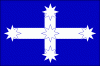
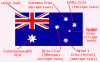
Hey, for a moment there, I thought you were talking about the Australian flag as it has the Southern Cross. Actually, there are two flags..one flag internationally recognised -- dark blue with the southern cross and the union jack on it. The second one is blue too but has the southern cross stars only in the middle of the flag.

Eeps..I know a bit more of Australian history rather than US history. :-x AND I'm American born, gee! I gotta kick myself back into school and take American History again :lol:
 

Attachments

  • eureka.gif
    eureka.gif
    2.4 KB · Views: 2
  • australian_flag.gif
    australian_flag.gif
    6.8 KB · Views: 2
Back
Top